
East Brunswick provides flat roof repair in East Brunswick, NJ, serving surrounding cities including East Hanover, Highland Park, South Amboy, Metuchen and Aberdeen. Low-slope roofs turn up on more houses than people expect, over rear additions, porches, garages, dormers and the flat sections of split-levels. In more than 20 years of roofing, we have repaired every common membrane on those roofs, along with the larger flat roofs on local shops and offices.
Flat roofs fail differently from shingle roofs. Water does not run off quickly, so it tests every seam, every flashing and every low spot. Repairs that last start with finding where water is getting in and why it is staying on the roof.
We identify the membrane first, because torch-down modified bitumen, EPDM rubber and TPO each need their own repair materials and methods. A patch that does not match the existing roof is a patch that fails at its edges.
Membranes We Repair
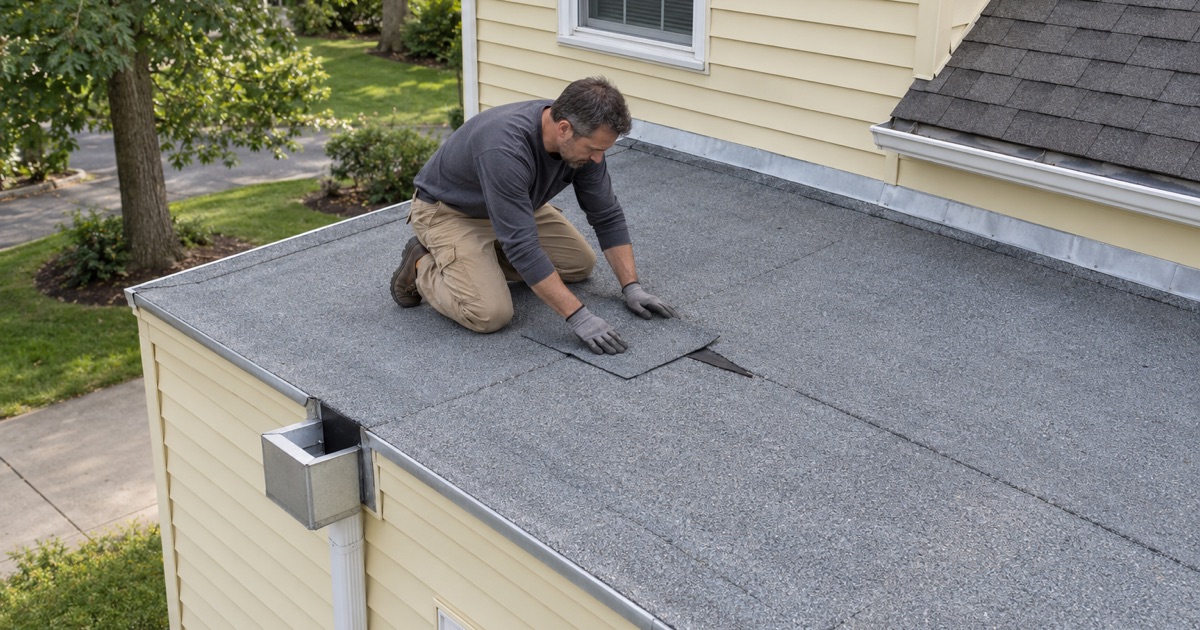
Torch-Down Modified Bitumen
Modified bitumen, in SBS or APP form, is the granulated sheet roofing common on porches, additions and older commercial roofs. It typically fails at laps that were never fully sealed, at blisters where moisture was trapped and at flashing where the roof meets a wall. Granule loss leaves the asphalt exposed to sunlight, which speeds cracking.
Repairs involve cutting out damaged sections and applying new membrane that overlaps sound material. Torch work needs fire precautions, and on houses with combustible siding nearby we often use cold-applied or self-adhered products instead.
EPDM Rubber
EPDM is a black rubber membrane found on many garages, additions and low-slope commercial roofs. The rubber itself lasts a long time, but seams held with older adhesives tend to open, and flashing around edges and penetrations shrinks away from walls. Punctures from dropped tools or branches are also common.
We clean and prime the rubber, then repair with compatible seam tape and cover strips. Patching EPDM with roofing cement or the wrong product leaves a bond that fails within a season.
TPO and PVC Single-Ply
TPO and PVC membranes are usually white or gray with heat-welded seams. When they leak, the cause is often a seam that was never fully welded, a puncture or flashing that has pulled loose around a penetration. Older TPO can become brittle and crack around fasteners.
Repairs on these membranes are welded with hot air using matching material. We test nearby seams with a probe while we are there, because one weak weld often means others.
Common Flat Roof Problems
Ponding Water and Clogged Drains
Water that sits on a low-slope roof for days ages the membrane and adds weight to the structure. Clogged drains, scuppers and gutters are the usual cause, along with sagging decks. We clear drains and note where ponding remains after they flow freely.
Persistent ponding can be reduced during a repair by adding tapered material in low areas, or more completely during replacement. Fixing drainage often stops leaks that patches alone could not.
Open Seams and Laps
Seams are the joints between sheets of membrane, and they are where flat roofs most often fail. Heat, cold and movement stress them, and poor original workmanship shows up there first. We inspect every seam on the roof, not just the one near the leak.
Flashing at Walls and Curbs
Where a flat roof meets a house wall, the membrane must turn up the wall and be covered by counter flashing or siding. When that detail fails, water runs behind the membrane at the top edge. Curbs for skylights, hatches and equipment have the same weak point. We rebuild failed wall and curb flashing with new membrane and metal so water is shed over the top of the detail rather than allowed behind it.
Blisters and Trapped Moisture
Blisters form when moisture or air trapped under a membrane expands in the heat. Small, stable blisters may be left alone, but large or broken blisters let water in. We cut and repair blisters that threaten the membrane.
Widespread blistering can point to wet insulation beneath the roof. In that case we check how far the moisture extends before recommending repair or replacement.
Punctures and Foot Traffic
Flat roofs over additions and porches are often walked on to reach windows or equipment, and every footstep wears the surface. Dropped tools and fallen branches puncture membranes as well. Small punctures are straightforward to repair when found early.
Where a roof gets regular traffic, walkway pads protect the membrane along the route. We suggest them on roofs where service visits are frequent.
Flat Roofs on Houses
Porches and Additions
The low-slope roofs over porches and rear additions usually tie into the main shingle roof or a house wall. The joint between the flat roof and the shingle roof is a frequent leak point, because two different systems meet there. We repair that transition with ice and water barrier and proper flashing.
Porch roofs also tend to be the lowest-pitched roofs on a house, so snow and leaves sit on them longest. Keeping the edge gutter clear matters more there than anywhere else, because a blocked gutter on a nearly flat roof turns the whole surface into a shallow pond.
Coatings on Older Membranes
A reflective coating can add years to a sound flat roof by sealing fine surface cracking and lowering summer heat. It cannot fix open seams, wet insulation or failed flashing, and applied over those problems it only hides them. We repair the defects first and recommend a coating only where the membrane beneath is still sound.
The coating has to suit the membrane, since some products do not bond to EPDM or TPO without special primers. We name the product in the estimate so you know what is going on your roof.
Garages and Dormers
Attached garages and shed dormers often carry EPDM or modified bitumen. Their edges meet gutters and walls, and leaks there can rot fascia or framing unseen. We repair the membrane and check the wood beneath it.
Repair Versus Replacement
A sound membrane with one failed area deserves a repair. A roof with cracking across its surface, many failed seams and soaked insulation does not. We explain which you have, with photos, before quoting either option.
- 20+ Years on Roofs
- Itemized Written Scopes
- Attic-First Leak Checks