
East Brunswick handles roof leak repair in East Brunswick, NJ, serving surrounding cities including East Hanover, Highland Park, South Amboy, Metuchen and Aberdeen. A leak is a detective job before it is a repair job. After more than 20 years of tracing water through local attics, we know that the brown spot on the ceiling is almost never directly beneath the hole that let the water in.
That is why every leak call starts inside. We follow the water back through insulation, along rafters and across the underside of the sheathing until we find where it first gets wet. Only then do we go on the roof to see what failed above that point, and only then do we price the fix.
The repair we recommend addresses the cause, not the symptom. A cracked pipe boot gets a new boot, a caulked chimney gets real flashing and a worn valley gets rebuilt. If the leak is one of many on a worn-out roof, we tell you that plainly too.
Leaks on Houses and Commercial Buildings
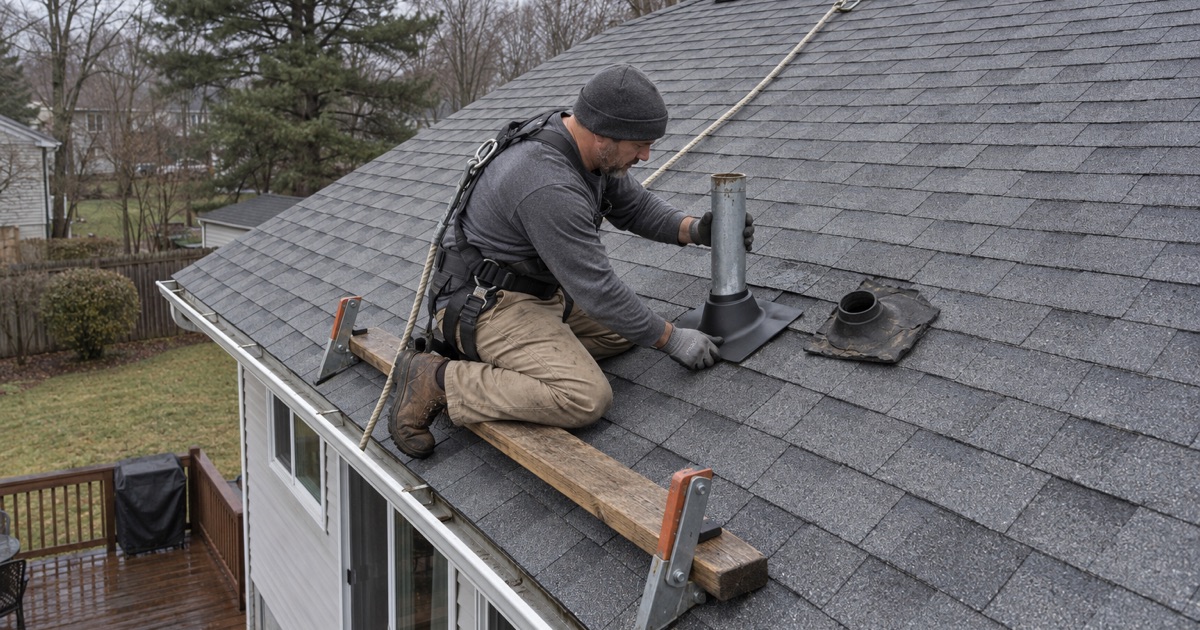
Residential Leak Repair
On houses, most leaks come from a handful of places: chimney flashing, pipe boots, skylights, valleys, wall joints and the eaves in winter. Split-levels and homes with additions add tricky intersections where one roof plane meets a wall or another roof. Those transitions are where water finds its way behind flashing that was never woven in correctly.
We repair leaks on asphalt shingle roofs, low-slope porch and addition roofs and metal accents. Each repair uses materials compatible with the existing roof, and the rest of the roof’s condition is noted so you know whether the leak is isolated or a sign of wider aging.
Commercial Leak Repair
Commercial leaks usually trace to low-slope membranes, where water can travel under the surface before dripping inside. Open seams, punctures from foot traffic, failed flashing at rooftop units and ponding at clogged drains are the usual causes. We inspect the whole roof, not just the area over the reported leak.
For occupied buildings we work around business hours and tenant spaces, and we document the source and the repair with photos for the owner or manager. Repeated leaks in the same building often point to drainage problems, which we explain alongside the repair.
Where Roof Leaks Start
Chimneys and Masonry
Chimney leaks are often blamed on the roof when the brick is part of the problem, and the reverse is just as common. Failed counter flashing, missing crickets behind wide chimneys and caulk smeared over joints let water in around the base. A cracked crown or open mortar joints let it in from above, inside the chimney.
We separate the two by checking the flashing and the masonry together. Flashing problems are fixed with new step and counter flashing set into a reglet. Masonry problems are explained with the crown, cap or repointing work they need, so you can fix both at once if necessary.
Pipe Boots, Vents and Skylights
Rubber pipe boots crack with age and let water follow the vent pipe into the attic, which is one of the most common leaks we trace. Exhaust vents and old satellite mounts often leak because they were sealed rather than flashed. We replace boots and flash every penetration so shingles shed water around it.
Skylights leak at the curb flashing or through the unit itself. Water-testing the area helps separate a flashing failure from a failed seal in the glass. That distinction decides whether the repair is new flashing or a new skylight.
Valleys, Walls and Dormers
Valleys carry concentrated runoff, and worn shingles or nails driven too close to the center line let water through. Walls and dormer sides depend on step flashing woven into every shingle course, with kick-out flashing at the bottom to steer water into the gutter. Missing kick-outs cause hidden rot behind siding.
Repairs in these areas often mean removing several courses of shingles to reach the flashing beneath. We rebuild the detail properly, with ice and water barrier underneath, rather than adding sealant on top that hides the problem for one season.
Ice Dams and Winter Eave Leaks
Ice dams form when heat escaping into the attic melts snow, which then refreezes at the cold eave and backs up under the shingles. The resulting leak shows up along exterior walls, often in late winter. Middlesex County is not in New Jersey’s mandatory ice-barrier area, so many older roofs here have no membrane at the eaves.
The immediate fix is clearing the dam and repairing damage. The lasting fix is improving attic insulation and ventilation so snow melts evenly, and adding self-adhering ice barrier at the eaves when the roof is next replaced.
Telling a Roof Leak From Something Else
Condensation in the Attic
In cold weather, warm moist air from the house can condense on the underside of the roof deck and drip onto insulation and ceilings. It looks like a leak but appears without rain, often on cold mornings. Frost on nail tips and widespread damp sheathing are the signs we look for.
The cure is ventilation and air sealing, not roofing. We check soffit intake, ridge exhaust and gaps around attic hatches and light fixtures, and we explain what will stop the condensation so you do not pay for a roof repair that cannot help.
Plumbing and Exhaust Fans
Bathroom fans vented into the attic instead of outside dump warm moist air that condenses and drips. Plumbing lines and air conditioning condensate lines in the attic can leak as well. Each of these can stain a ceiling in a way that looks exactly like rainwater.
When the stain does not line up with rainfall or with any roof failure, we say so. Pointing you toward a plumber or a duct extension saves you money and time compared with repairing a roof that was never the problem.
Gutters and Overflow
Clogged or undersized gutters overflow behind the fascia and can soak the wall below the eave. Water may enter at the top of the wall and show up inside as a leak near the ceiling line. We check gutter size, pitch and cleanliness during every leak inspection.
If the gutter is the cause, cleaning or resizing it may be the only repair needed. Where fascia has rotted, we replace it and add drip edge so water lands inside the gutter instead of running behind it.
From Temporary Fix to Permanent Repair
Stopping Water Now
When water is coming in during a storm, we tarp the affected area to protect the inside of the house. Damage is photographed before covering, which helps if the leak came from a storm. The tarp is fastened to hold through more weather until a permanent repair can be made.
The Lasting Repair
Once the roof is dry, the failed part is replaced with matching materials and properly installed flashing. We check the repair from the attic during the next rain when possible, or ask you to watch the same spot. A repair is only finished when that ceiling stays dry.
If the leak is one of several and the roof is near the end of its life, we explain that along with the repair price. You decide whether to repair now and plan replacement, or replace the roof outright.
- 20+ Years on Roofs
- Itemized Written Scopes
- Attic-First Leak Checks