East Brunswick handles storm damage roof repair in East Brunswick, NJ, serving surrounding cities including East Hanover, Highland Park, South Amboy, Metuchen and Aberdeen. Thunderstorms, nor’easters and the remnants of tropical systems all pass through central New Jersey, and each leaves a different kind of mark on a roof. In more than 20 years of roofing, we have learned that the record made in the days after a storm matters almost as much as the repair itself.
Our storm work has two parts. First, we inspect and document the damage with photographs and a written description you can use for your own insurance claim. Second, we repair or replace what the storm damaged, using materials matched to the existing roof.
We keep to the roofing side of the claim. When you ask, a member of the crew will meet your adjuster on site, but the claim stays yours, and New Jersey reserves negotiation for licensed public adjusters.
Types of Storm Damage
Wind-Lifted and Missing Shingles
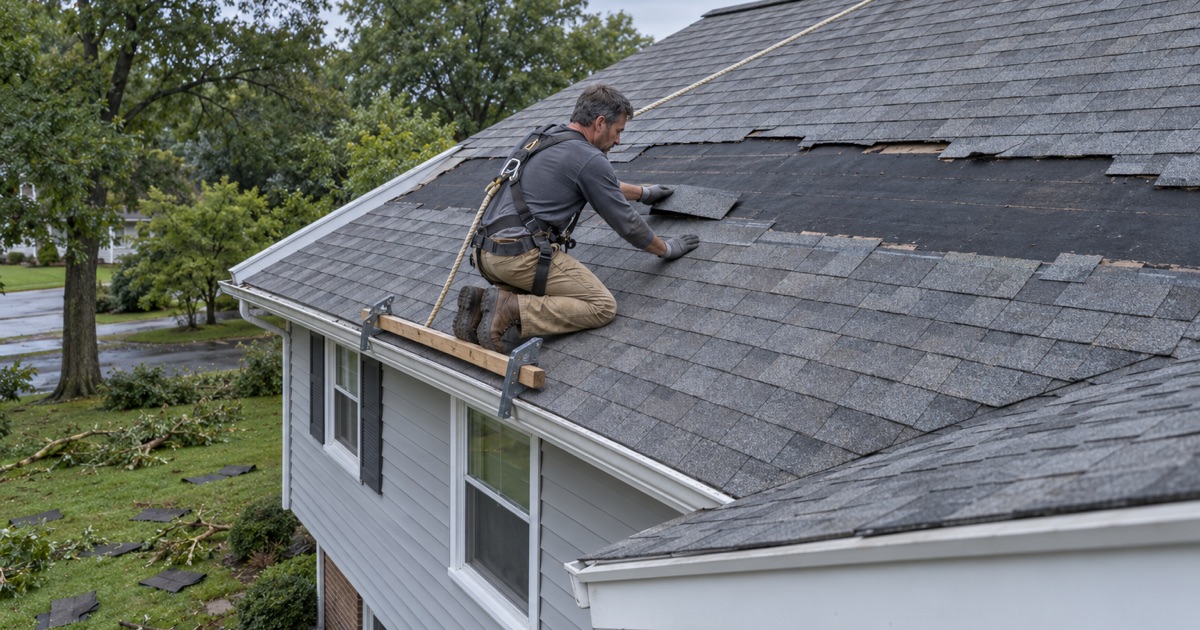
High wind breaks the seal strips that bond shingles together, then flexes the loose tabs until they crease or tear off. A roof can look intact from the ground while dozens of shingles have broken seals. We lift tabs by hand across the roof to find the extent of the damage.
Creased shingles may stay in place for months before they fail, which is why they belong in the damage record right away. Shingle wind ratings such as ASTM D3161 Class F and D7158 Class H describe how well a shingle resists uplift, and we note the type on your roof.
Hail Impacts
Hail bruises asphalt shingles, knocking granules loose and cracking the mat beneath. The damage often shows more clearly on soft metal such as vents, gutters and flashing, where dents mark the size and direction of the hail. We photograph both, because the metal helps confirm what happened to the shingles.
Impact-rated shingles carrying a UL 2218 Class 4 rating resist hail better than standard shingles. If your roof needs replacement after a hail claim, we can explain the options.
Fallen Limbs and Trees
A falling limb can crack decking, break rafters and puncture the roof in ways that are hard to see from below. After the tree is removed, we inspect the framing as well as the surface. Hidden structural damage needs to be in the record before repair begins.
We coordinate with tree crews when limbs are still on the roof. Once the weight is off, we tarp the opening and document the damage.
Flashing, Gutters and Edges
Wind pulls at roof edges, lifting drip edge, bending gutters and loosening flashing. These parts often fail first in a storm and can let water in even when the shingles survive. We inspect edges, gutters and flashing at chimneys, walls and skylights as part of every storm inspection.
Documenting Damage for Your Claim
Photographs That Tell the Story
We take wide shots to show where on the roof the damage sits and close-ups to show what it looks like. Each photo is matched to a location on the roof, so the adjuster can follow the record. Damage to gutters, vents and siding is included because it supports the roof findings.
A Written Description
The write-up describes each damaged area, what we observed and what repair it needs. It separates fresh storm damage from older wear that was already present. Insurers deny claims that read as aging, so that separation is important.
Meeting the Adjuster
When you ask, a member of our crew meets the insurance adjuster on site and walks the roof with them. That lets the adjuster see the damage we documented rather than relying on a description. We answer questions about the roof and leave the claim decisions to you and your insurer.
New Jersey Insurance Rules Worth Knowing
The Hurricane Deductible Trigger
New Jersey’s uniform homeowners policy language applies a hurricane deductible only when a hurricane named by the National Weather Service brings hurricane-force sustained winds measured in the state. DOBI Bulletin 11-16 explains the trigger. Sandy did not qualify, because the weather service had reclassified it before landfall.
Most storm claims, including thunderstorms and nor’easters, use your regular deductible. Knowing which applies helps you estimate what you will pay before the adjuster arrives.
Public Adjusters and Contractors
New Jersey’s Public Adjusters’ Licensing Act allows only licensed public adjusters to negotiate claims for policyholders. A roofer who promises to handle your claim is offering something the law does not allow. We document, repair and meet adjusters, and that is where our role ends.
State Guidance for Homeowners
The New Jersey Department of Banking and Insurance publishes storm claim guidance covering what to do after damage, how to work with adjusters and what to do if you disagree with a decision. It is a good resource to read before a claim is filed.
Repairing the Damage
Matching Materials
Repairs use shingles matched to your roof’s line and color as closely as possible. When the original is discontinued, we show you the nearest match before installing it. Flashing and edge metal are replaced to match the existing details.
When the Damage Means Replacement
If storm damage is widespread or the roof was already near the end of its life, replacement may be the sensible outcome. We explain why with photos and price it with an itemized scope. A full replacement is exempt from New Jersey sales tax with Form ST-8, while repairs are taxable.
Contracts and Cancellation Rights
Storm repair contracts follow New Jersey’s home improvement rules, including the three-business-day cancellation notice. That protects homeowners from pressure after a storm, when door-to-door offers are common. We encourage you to read the scope and compare it before deciding.
- 20+ Years on Roofs
- Itemized Written Scopes
- Attic-First Leak Checks